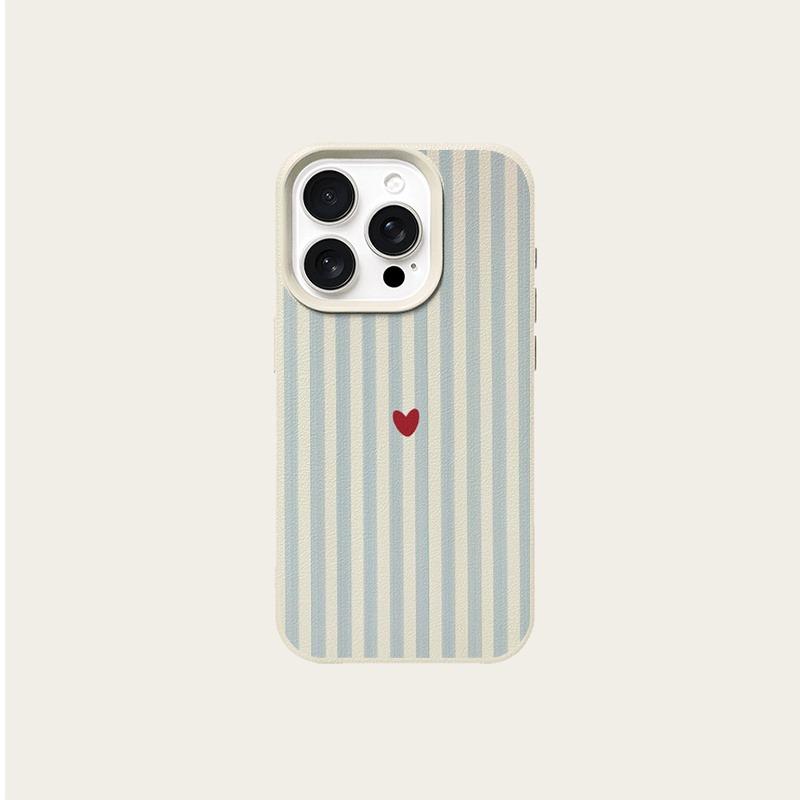

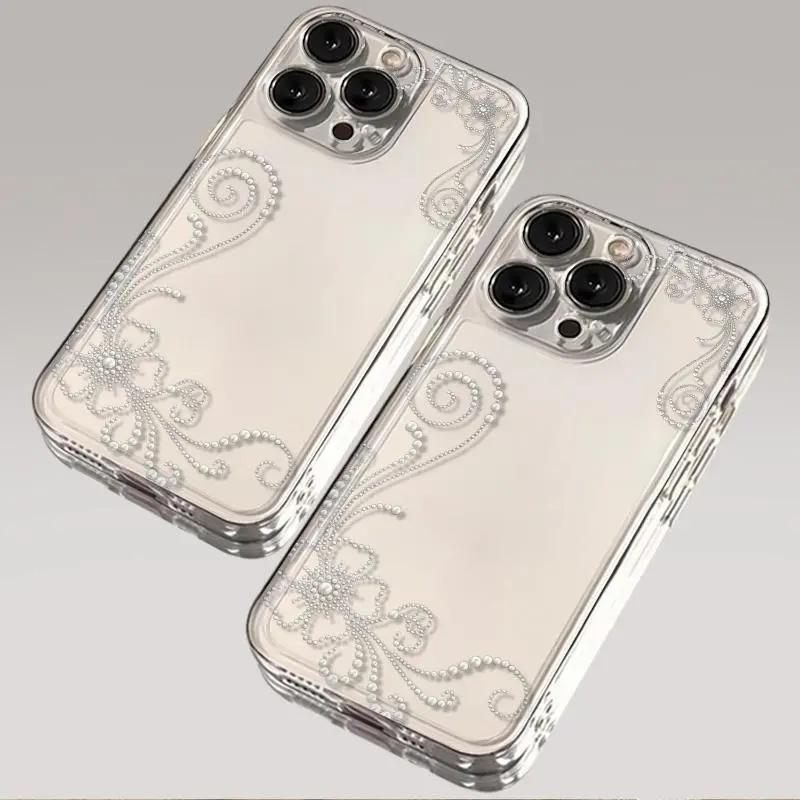
The camera opening is the largest shape in the upper-left corner of each photograph, but the pattern responds to it three different ways. Pale vertical bands stop at its boundary. Tiny bows, flowers, hearts and stars continue beside and below a broad void. Beaded-looking curls approach the corner as part of an ornamental border. The useful comparison begins with those visible relationships, not with a style label or a claim about how the cases were made.
01 — Read the opening as a shape
Keep each supplied photograph uncropped and identify two boundaries: the outer case edge and the camera opening inside it. The visible pattern lives between them. This makes the missing upper-left area part of the composition without pretending to know what is hidden beneath the photographed hardware or how a production file was prepared.
02 — Interrupted: vertical bands stop at the corner
In the first photograph, narrow pale-blue-looking and cream-looking bands run vertically across the visible back. At the upper-left, the camera cluster occupies the space where several bands would otherwise continue. The bands remain visible immediately to the right and below the cluster, while one small red heart sits lower and closer to the center. The opening interrupts the repeat; the heart supplies a separate focal mark.
03 — Dispersed: small motifs continue around a broad void
In the second photograph, the camera opening appears as one large pale shape against a dark-blue-looking field. Small bows, flowers, hearts and stars remain visible to its right and resume below it. Their scale and spacing make the opening read differently from the scattered marks: one broad void surrounded by many small motifs. Do not infer material, texture or camera clearance from the photograph.
04 — Bordered: curls and flowers turn the corner into an endpoint
The third catalog image shows two angled views of the same ornamental case design. Beaded-looking curls and flowers run near the outer edges, leaving much of each center comparatively open. Near the top, a flourish sits to the right of the camera cluster rather than crossing it. The camera corner becomes one endpoint of an asymmetrical border, not the center of the ornament.
05 — Compare the nearest mark, then stop
Ask the same question of all three images: what happens to the nearest visible mark at the opening? The stripe ends at the boundary; the tiny motifs continue around it; the flourish approaches it as part of a border. Those are three observable compositional relationships, not a quality ranking, a shopping quiz or a claim about the person who might carry the case.
Image note: These are current catalog photographs of the exact cases discussed, shown in their complete supplied frames. They support observations about visible bands, motifs, curls, flowers, edge relationships and the camera opening—not designer intent, hidden artwork, a production template, exact color, material, texture, print method, finish, fit, camera clearance, charging, protection or durability.
OBJECTS IN THIS STORYFollow the nearest visible mark when it reaches the opening.