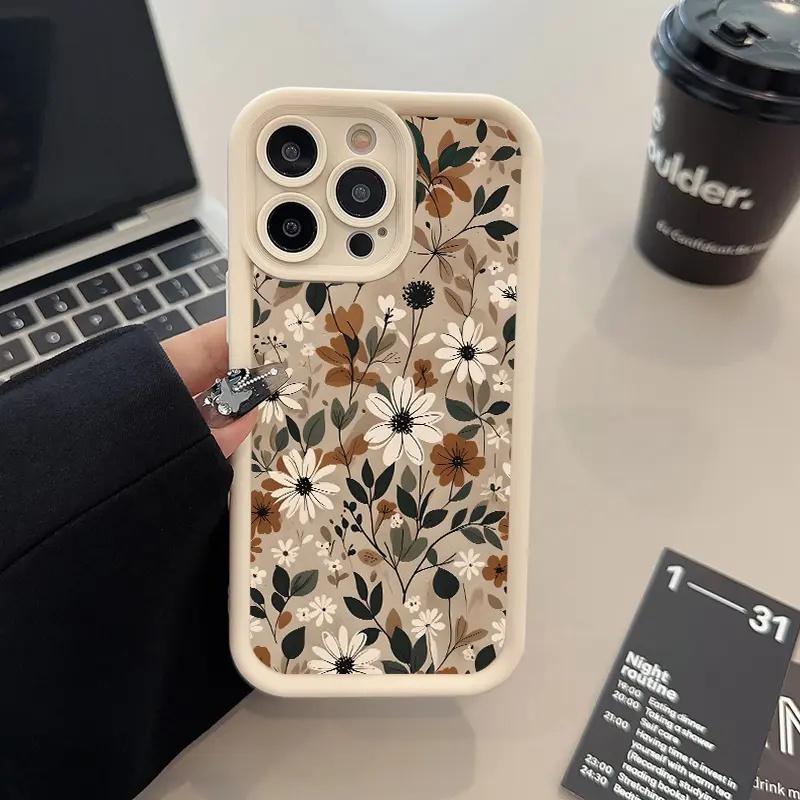

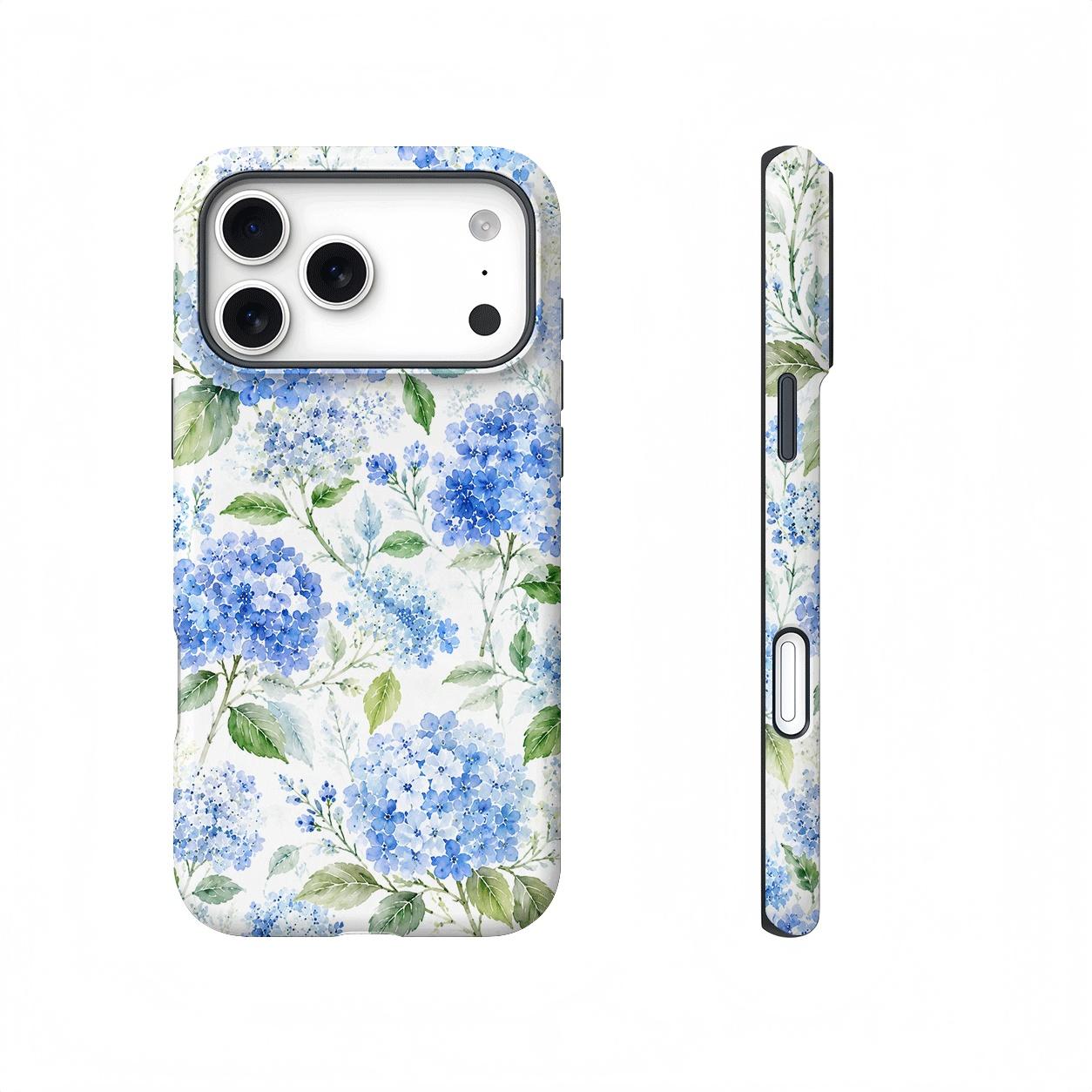
The brown case leaves narrow cream channels between small stems and blossoms. The violet case enlarges overlapping petals until very little ground remains. The blue case separates flower clusters with wider pale intervals. All three are floral; the useful difference is how much ground remains visible and how the motif occupies it.
Treat the visible ground as a compositional element rather than a mood cue. Compare how much ground remains, how large and overlapping the motifs are, and where forms meet the case edge. These three exact catalog photographs support a structural comparison; they do not establish an owner's personality, a historic style, a printing process or a material fact.
01 — Count the ground as a shape
Background is not what remains after the motif. Its visible paths and intervals organize the pattern too. Record whether those paths are narrow, nearly absent or broad enough to separate clusters.
02 — Small stems leave narrow channels
In the brown catalog image, small blossoms, dark leaves and branching stems cover most of the visible back. Cream ground remains in narrow, irregular channels between the repeated forms. Several stems and leaves approach or cross the photographed case boundaries.
03 — Enlarged petals reduce the exposed ground
The violet image shows large violet and blue lotus-like forms overlapping across almost the entire photographed field. Only small pockets of background remain between petals, and multiple petals are cropped by the side and lower boundaries.
04 — Separated clusters create wider intervals
The blue image places flower clusters apart rather than forming one continuous mass. Wider pale intervals remain between them, while smaller green stems and leaves connect areas where some blue-to-green transitions look gradual. “Watercolour-like” describes that depicted edge effect only—not paint, paper, ink, printing process, finish or material.
05 — Compare three structures, not three personalities
The three observable constructions are small repeated stems with narrow channels, enlarged overlapping petals with little exposed ground, and separated clusters with wider intervals. The photographed edge crops belong to these supplied views and do not promise how the composition meets every phone model.
Follow the ground, then name the motif
Trace one uninterrupted patch of visible ground, then name whether the motif around it is repeated, enlarged or clustered.
Image note: These are current catalog photographs of the exact cases discussed. They support observations about visible ground, motif scale, overlap, secondary stems or leaves and photographed edge crops—not exact color, material, finish, texture, manufacturing process, fit or performance.
OBJECTS OBSERVED