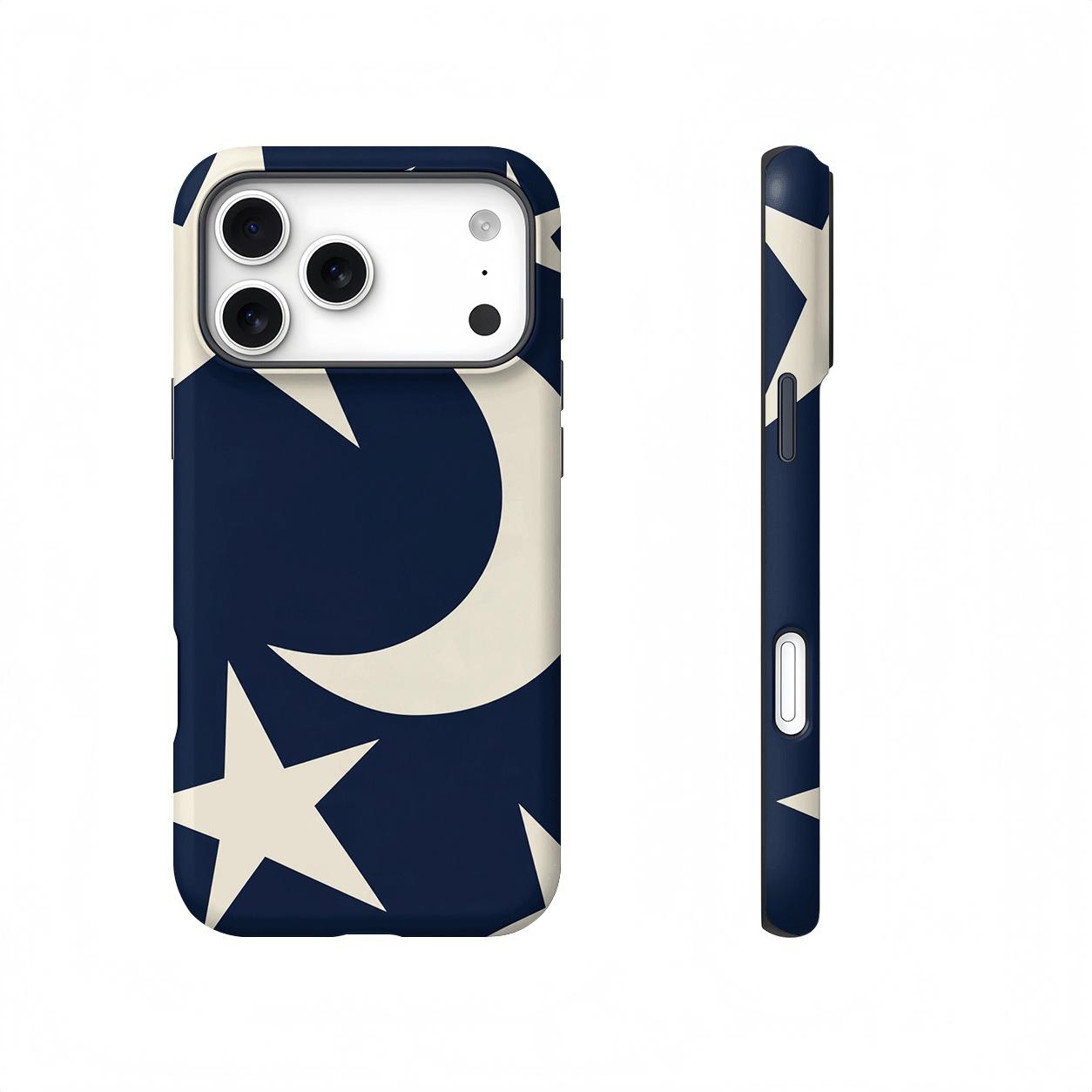
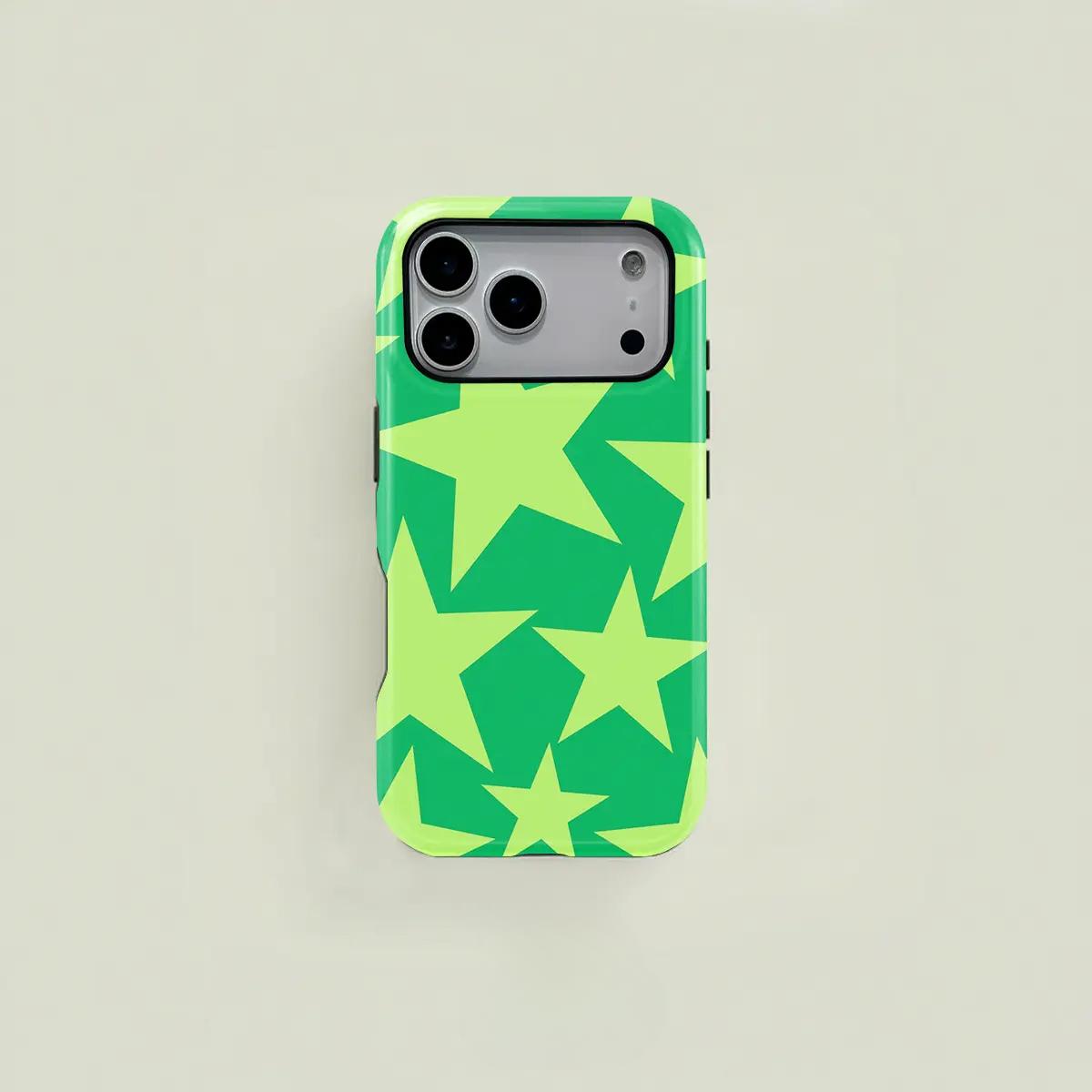

The first image pairs one large star with an oversized crescent. The second repeats stars of several sizes across the case. The third does not center a five-pointed star at all: it spells “STAR” across a rounded graphic with a crown, halo and hearts. The motif changes because its neighbors and structure change.
The fixed opening can interrupt a repeat, gather smaller marks around a void or anchor one end of a border. These photographs show those three visible relationships without telling us why a designer chose them or what may sit beneath the hardware.
01 — Name the role before the meaning
A familiar shape can work as a focal figure, one unit in a repeated field or a word inside a graphic cluster. Start by naming that visible job and the neighboring forms that produce it. Leave luck, destiny, energy, mood and identity with the reader unless a real person explicitly supplies that interpretation.
02 — Star plus crescent becomes a scene
In the navy catalog image, an oversized cream crescent occupies much of the upper and middle field. A large five-pointed star sits near the lower-left edge, while smaller star fragments enter near the top and lower-right boundaries. The crescent-star relationship makes a compact pictured scene; the image does not establish astronomy, religion, astrology or the owner's beliefs.
03 — Repeated stars become a field
The green case repeats light five-pointed stars at several sizes across a darker ground. The largest star sits below the camera opening, smaller stars fill the lower half, and multiple shapes are cut by the top, side and bottom boundaries. Call this a repeated field rather than a tessellation: the photograph shows recurring shapes, but not a seamless geometric unit or exact symmetry.
04 — The word “STAR” becomes a graphic label
The third catalog photograph shows four colorways sharing one central arrangement. The outlined word “STAR” crosses a rounded vertical form, with a small crown, halo and heart marks around it. Here letters name the motif instead of a five-pointed star carrying the composition. The group image supports the shared arrangement only; it does not confirm current color availability for every phone model.
05 — Compare structure without assigning a person
End with three plain descriptions: scene, repeated field or word-image. Then note the visible neighbor that creates each role—the crescent, other stars or the crown-halo-heart cluster. This comparison remains useful without a purchase link and without turning one common shape into a horoscope, mood promise or personality test.
Three questions about the missing corner
How does a camera opening change a phone-case pattern? Treat the outer case edge and the camera opening as two frames. Then follow the nearest visible mark: it may stop at the opening, resume around it or approach it as part of a border.
Can a catalog photograph prove why a motif was placed beside the camera opening? No. A photograph can support observations about the visible crop and spacing, but it cannot establish the designer’s intention, the production file or artwork hidden beneath the phone hardware.
Does the same pattern meet every phone model’s camera opening in the same way? Not necessarily. Camera layouts and crops can vary by model, so use the exact current product photographs and confirm the selected model on the product page.
Trace, name, record
Trace the boundary. Follow the camera opening before reading the surrounding pattern.
Name the nearest mark. Identify the stripe, tiny motif or border flourish closest to that opening.
Record the relationship. Is the mark interrupted, routed around the opening or used as part of a frame?
Image note: These are the current primary catalog photographs of the exact cases discussed, shown uncropped with the complete supplied image visible. They support observations about the photographed pattern and camera opening only—not design intention, a production template, exact color, material, finish, fit, camera clearance, protection or durability.