
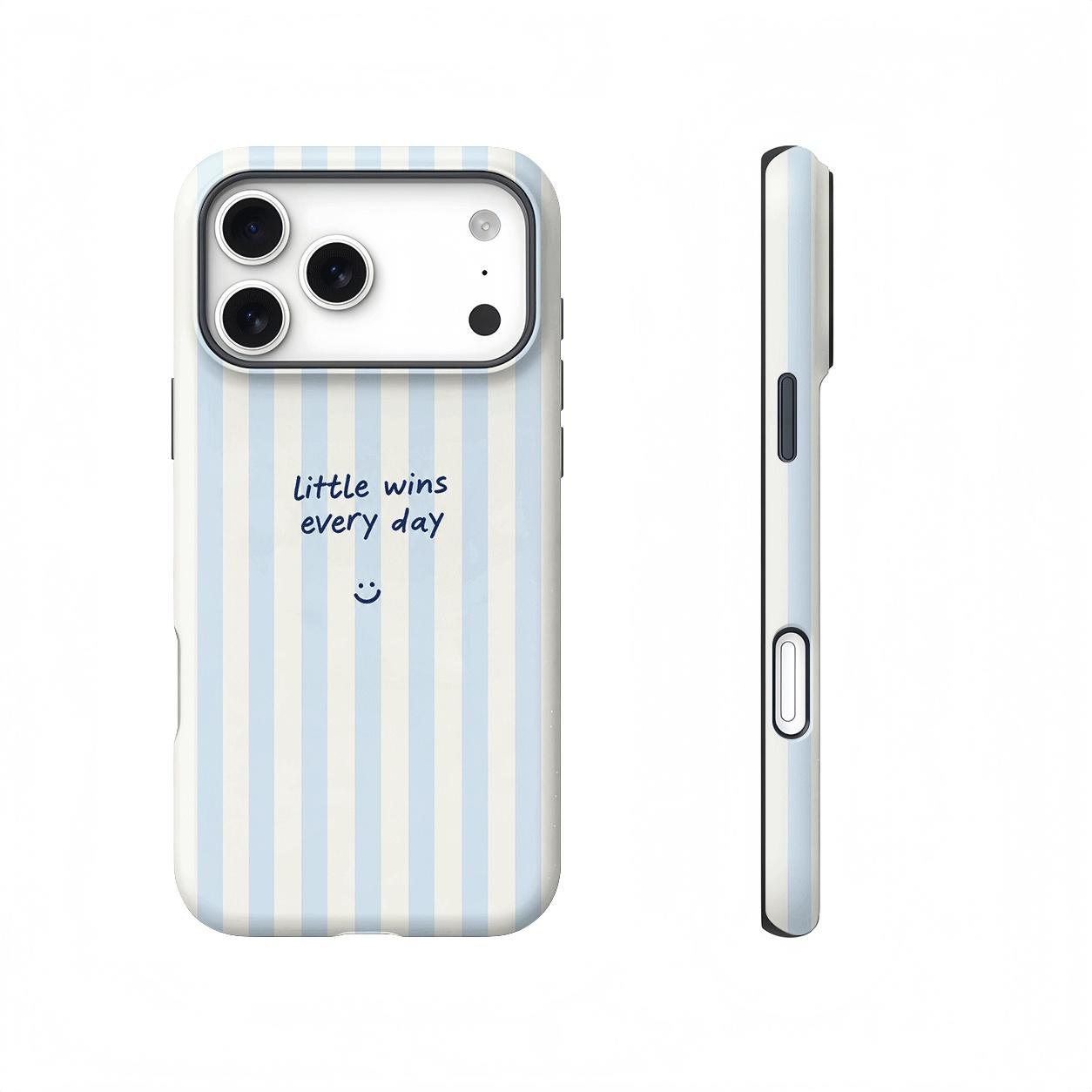
Some words ask something of you. Others simply place an idea nearby. On one case, MAKE / WHAT / YOU / ADORE descends through four large lines. On the other, “little wins / every day” gathers into two small lines above a smile mark. Before deciding how either phrase feels, notice how it addresses you and how long your eye takes to move through it.
01 — Start with what the sentence does
“Make what you adore” uses an imperative form: the sentence asks its reader to act. “Little wins every day” states an idea without issuing the same kind of request. That grammatical difference is visible in the wording itself. It does not require a claim about motivation, confidence, wellness or the personality of whoever carries the case.
02 — Four lines make the request arrive in steps
In the first catalog image, the words are split into four large stacked units—MAKE, WHAT, YOU, ADORE—across most of the visible back. The eye moves downward one unit at a time. A fine cream-looking grid covers the field, and small four-point marks sit beside the lettering. The phrase is both text and the largest graphic form in the image.
03 — Two compact lines keep the observation together
In the second image, “little wins” and “every day” form a small handwritten-style cluster near the center, with a curved smile mark below. Pale blue-looking and cream-looking vertical stripes continue above and below the words. Because the text occupies less of the back and uses only two short lines, it reads as one compact unit within a larger striped field.
04 — Repetition belongs to the reader, not the catalog
A phone case may be seen repeatedly, but the catalog photographs cannot predict what repeated reading will do for a particular person. The practical question is smaller: do you want to encounter a request, an observation or no phrase when you turn the phone over? A personal answer can change without making either sentence a universal promise.
05 — Let the sentence remain smaller than a self-description
Choosing words for an ordinary object does not require turning them into a biography. Read the verb, notice the line breaks, and decide whether that form of address is welcome. The case can carry one sentence without making the sentence explain its owner.
Image note: These are current catalog photographs of the exact cases discussed, shown in their complete supplied frames. They support observations about literal wording, line breaks, scale, placement, grid, stripes, four-point marks and the smile mark—not exact color, font identity, authorship, material, texture, print method, finish, grip, fit, charging, camera clearance, protection, durability or psychological effect.
OBJECTS IN THIS STORYWould you rather repeatedly encounter a request, an observation or no wording at all?